Recently, the team of particle physics from the School of Physics and Technology of University of Jinan (UJN), in collaboration with the team of theoretical particle physics from the Institute of Frontier and Interdisciplinary Science of Shandong University, has achieved significant progress in the theory of high energy spin physics by proposing a novel method of extracting gluon polarization information through energy-energy correlations (EEC). Their relevant research paper, entitled “Gluon Polarimetry with Energy-Energy Correlators”, has been published in the top physics journal Physical Review Letters with UJN as the first institution.
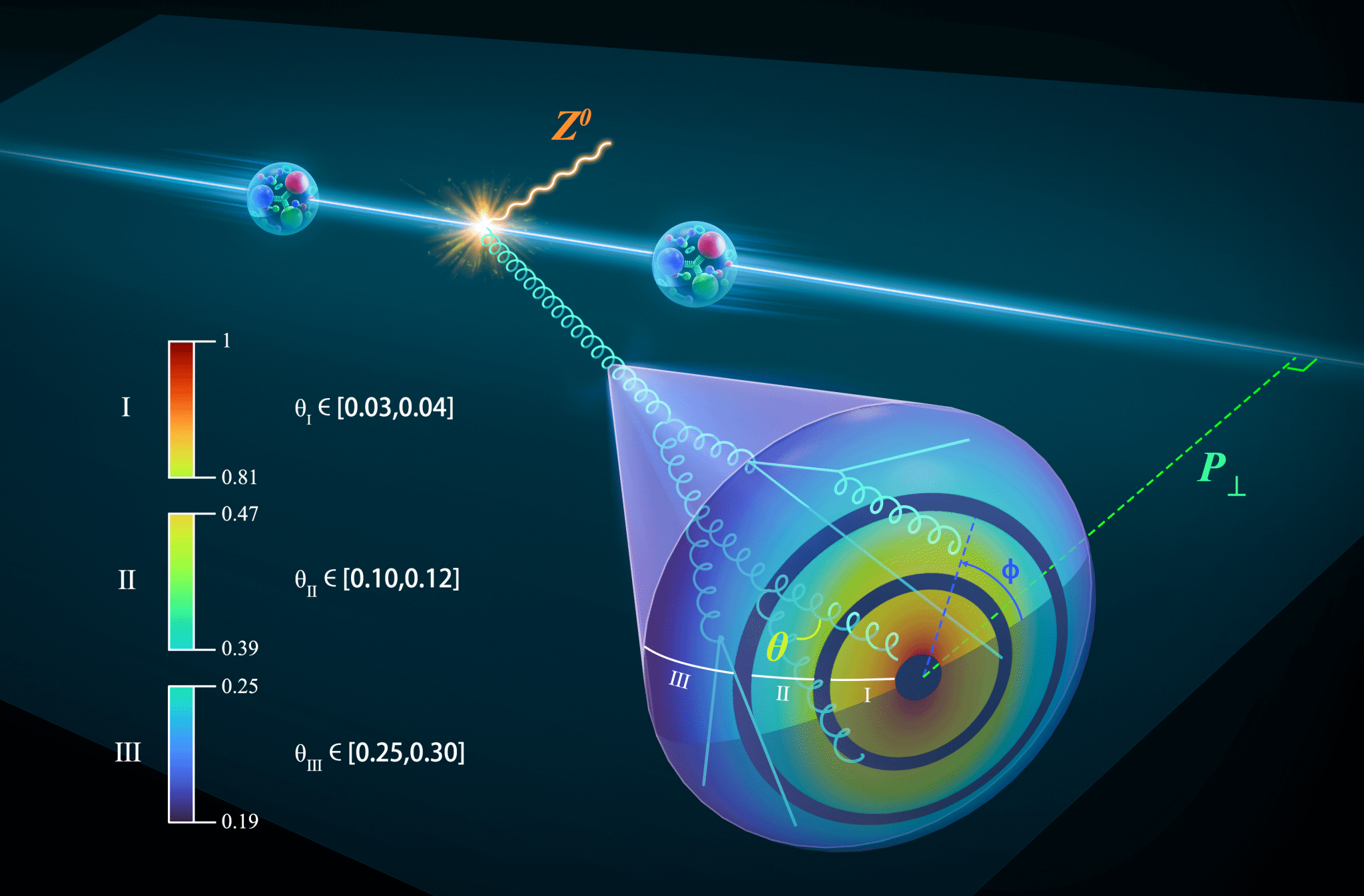
In the small-x region at the dilute limit, gluons inside nucleons exhibit significant linear polarization. This phenomenon is not only the key to the complicated three-dimensional internal structure of nucleons, but also an indication of the microscopic mechanism of quantum entanglement. However, directly measuring linear gluon polarization remains a major challenge.
Traditional methods are mainly based on transverse-momentum-dependent factorization, and linear gluon polarization is measured through azimuthal asymmetries of final-state hadrons. These methods suffer from two key limitations. On the one hand, the polarization signal is diluted by QCD evolution effects at low transverse momentum, rendering the true signal quite faint. On the other hand, identical azimuthal asymmetries can also arise from final-state soft gluon emissions as a background effect contaminating the extraction of gluon polarization severely, limiting the precision of measurement significantly.
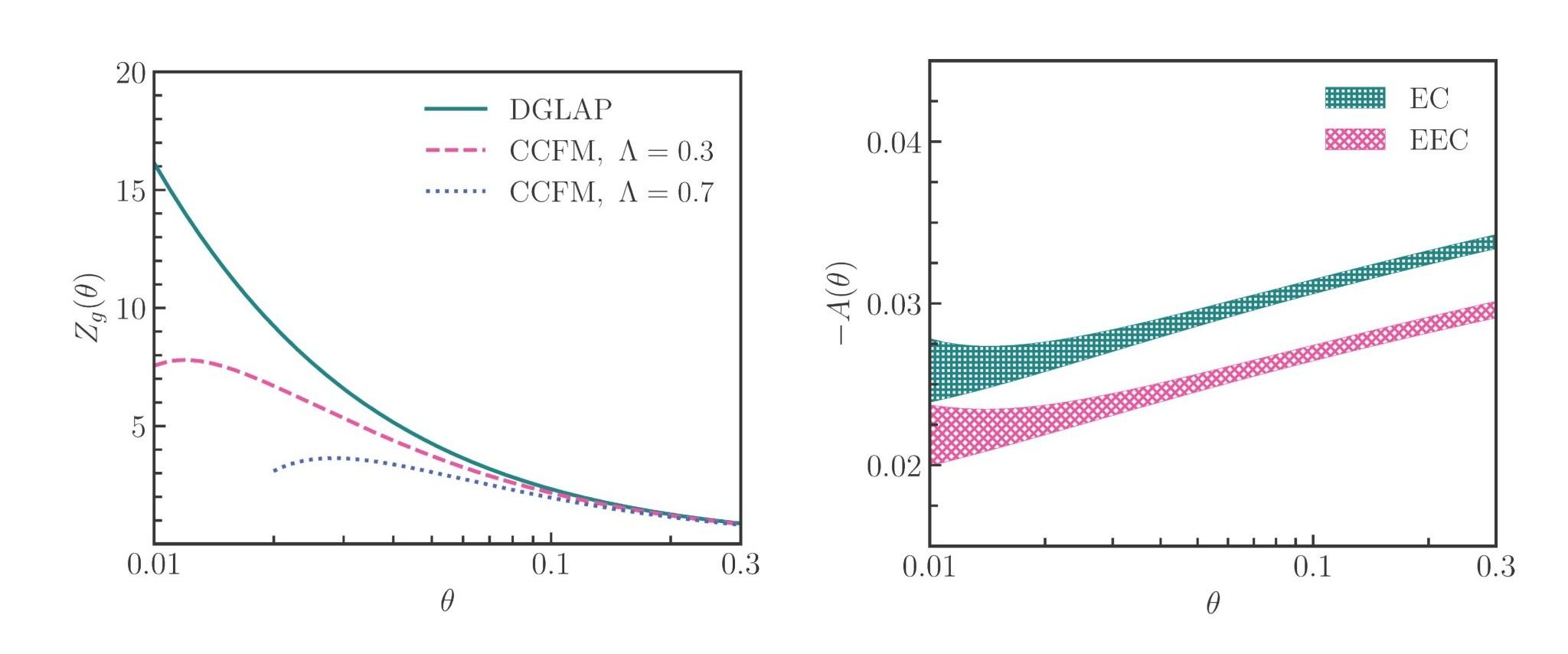
To address these challenges, the research team introduces a novel approach to probe the gluon linear polarization based on the cos2φ azimuthal asymmetry of EEC. The energy-weighting of this approach helps to avoid the contamination from final-state soft gluon radiations, offering a theoretically more robust and experimentally more accessible avenue for gluon polarimetry. To achieve improved precision, the research team implements angular ordering to account for the quantum coherent branching effects within the CCFM formalism. Accounting for the quantum coherence effects and introducing the non-perturbative parameter Λ, they naturally reproduce the characteristic plateau behavior of EECs, providing a unified framework for the smooth transition from perturbative to non-perturbative regions.
Authors of the paper include Assoc. Prof. Yu-Kun Song from University of Jinan, Research Fellow Shu-Yi Wei, Prof. Jian Zhou and PhD student Lei Yang from Shandong University. Lei Yang graduated from University of Jinan in 2022. This work is supported by the National Natural Science Foundation of China, the Shandong Provincial Natural Science Foundation, and the Taishan Fellowship of Shandong Province for junior scientists.
Physical Review Letters is an academic journal published by the American Physical Society (APS). The recent impact factor of this journal is 9.0, and it is the top Q1 journal of physics for many years. This is the first article published in Physical Review Letters by the School of Physics and Technology as the first institution.
Link to the article: https://journals.aps.org/prl/abstract/10.1103/j24j-ydvy